
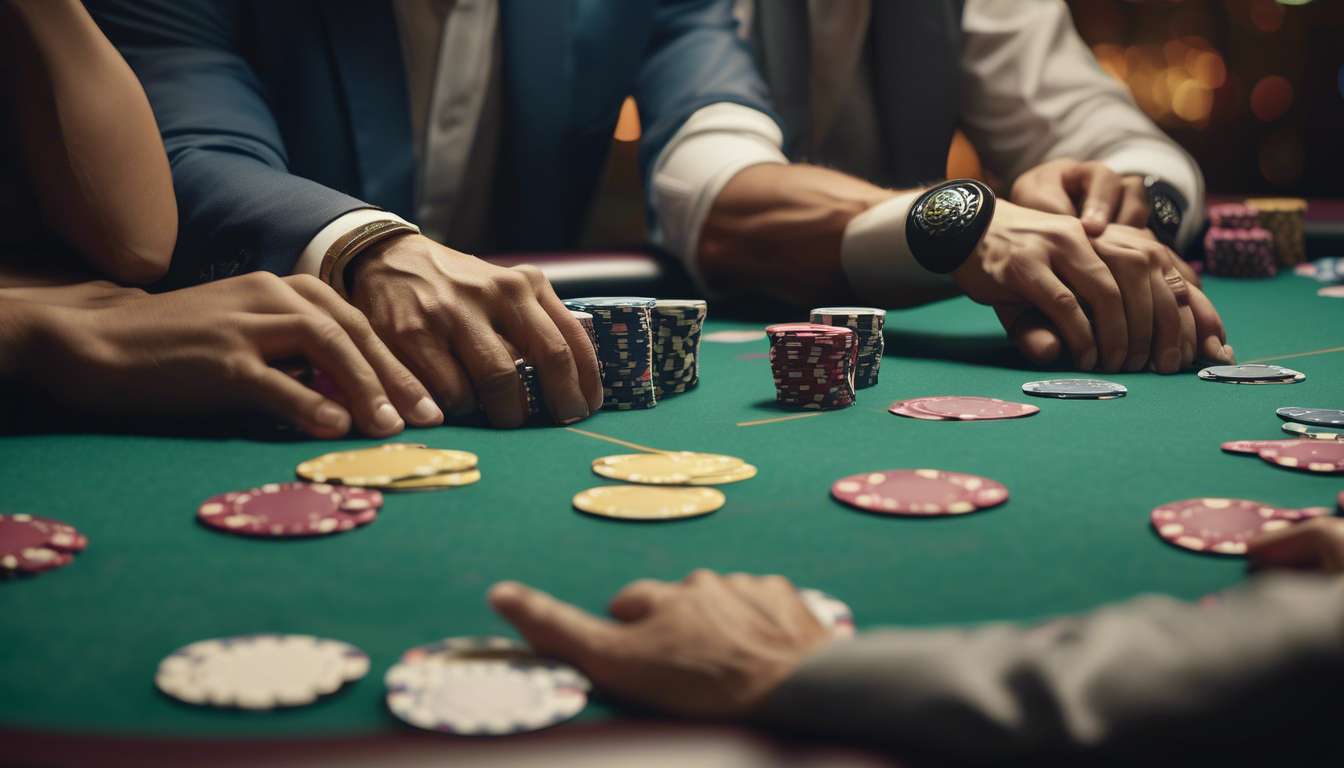
In the thrilling world of poker tournaments, understanding table dynamics is crucial to our success. As players, we must constantly adapt to the ever-changing environment, where each hand presents new challenges and opportunities. Recognizing these dynamics allows us to make informed decisions, giving us an edge over our opponents.
Key Elements Influencing Table Dynamics:
-
Observing Player Behavior:
- Pay attention to how opponents react in different situations.
- Look for patterns in their play style, such as aggressive or conservative approaches.
-
Betting Patterns:
- Analyze how players bet in various scenarios.
- Identify any tells or consistent betting habits that can be exploited.
-
Shifts in Momentum:
- Notice when the flow of the game changes.
- Be prepared to adjust your strategy when momentum shifts in your favor or against it.
By honing our ability to read the table, we can anticipate moves, exploit weaknesses, and ultimately improve our chances of taking home the prize.
Whether we are seasoned veterans or newcomers looking to elevate our game, mastering table dynamics is an essential skill in our poker arsenal. Let’s dive into the strategies and techniques that will enhance our tournament performance.
Player Tells and Reactions
In poker tournaments, keen observation of player tells and reactions is essential for gaining an edge over opponents. It’s not just about the cards; it’s about understanding the subtle nuances of player behavior.
Player Tells:
- Tapping fingers
- Avoiding eye contact
These tells can reveal the strength or weakness of a player’s hand. Recognizing these signs allows us to make tactical adjustments aligned with our shared goal of success.
Betting Patterns:
- Sudden increase in bet size
- Hesitation before calling
These patterns can indicate a shift in confidence or strategy. By interpreting them, we can predict our opponents’ next moves and adapt accordingly.
Together, by sharing insights and observations, we enhance our collective game. This fosters a sense of camaraderie and belonging, improving us individually and elevating our team’s overall performance in the tournament.
Strategic Observation Techniques
We focus on honing our strategic observation techniques to gain insights into opponents’ behaviors and tendencies. By attentively watching player behavior, we begin to understand the subtle nuances that separate a casual player from a skilled one. Our community thrives on this shared knowledge, as we recognize that deciphering these behaviors gives us a strategic edge.
Observing player reactions in different situations helps us predict future actions and make informed tactical adjustments. For instance, we note:
- How some players might tense up during critical hands
- How others might relax when they have a strong hand
These cues, while subtle, reveal significant information about their strategies.
Keeping a keen eye on betting patterns allows us to identify shifts in a player’s approach, indicating whether they’re bluffing or holding a strong hand.
Together, these strategic observation techniques empower us to stay one step ahead, fostering a sense of unity as we navigate the dynamic world of poker tournaments.
Identifying Betting Patterns
We meticulously analyze betting patterns to uncover hidden strategies and anticipate our opponents’ next moves.
By observing player behavior, we can detect subtle cues and adjust our tactics accordingly. A player’s betting pattern often reveals their confidence, hand strength, or even bluffing tendencies. By paying close attention, we can identify whether an opponent consistently raises with strong hands or bluffs when they sense weakness.
In our quest for mastery, we develop an innate sense of when a player is deviating from their usual betting habits.
These deviations often indicate a change in their strategy, giving us the opportunity to make tactical adjustments. For instance, if a typically conservative player suddenly starts betting aggressively, we might infer they’re holding a powerful hand or trying to shake things up.
By fostering a sense of camaraderie and shared understanding at the table, we position ourselves as part of a community that thrives on mutual respect and competitive spirit.
Together, we refine our skills and strengthen our strategic arsenal.
Adapting to Momentum Shifts
In poker tournaments, momentum can shift rapidly, and we must swiftly adapt our strategies to maintain an edge over our opponents. Recognizing these shifts is crucial for our success.
We need to be vigilant in observing player behavior, as it often signals a change in the game’s flow. When an opponent suddenly becomes more aggressive or starts making unexpected moves, it’s a clear sign that the table dynamics are shifting.
We should also pay close attention to betting patterns:
- A player who’s consistently raising might indicate rising confidence or a strong hand.
- A cautious check could suggest hesitance.
By analyzing these patterns, we can make informed tactical adjustments that align with the new momentum.
As part of a community of skilled players, it’s essential for us to stay adaptable. We share the understanding that poker is more than just cards; it’s a game of ever-changing dynamics.
Together, we can navigate these shifts and strengthen our game.
Exploiting Opponents’ Weaknesses
Identifying opponents’ weaknesses allows us to strategically capitalize on their vulnerabilities and gain a decisive advantage in poker tournaments. Together, we can observe player behavior and spot inconsistencies in their betting patterns.
- When we notice that a player tends to overbet with strong hands but underbet with weak ones, we can exploit this by:
- Folding when they overbet
- Raising when they underbet
This understanding creates a sense of camaraderie as we navigate the table dynamics together.
Recognizing playing styles also helps us make tactical adjustments:
-
If an opponent plays too aggressively:
- We can call their bets with a wider range of hands.
-
If an opponent plays too passively:
- We can apply pressure with well-timed bets.
Sharing these insights and strategies with each other fosters a sense of belonging and mutual growth within our poker community.
By honing our ability to detect weaknesses, we enhance our collective skills and increase our chances of success.
Anticipating Moves and Decisions
We sharpen our strategic edge by predicting our opponents’ next moves and adjusting our tactics accordingly.
When we recognize player behavior at the table, we gain insights into their betting patterns. This understanding isn’t just about observing; it’s about connecting with the rhythm of the game and the players within it. It’s about belonging to an exclusive circle of minds that think two steps ahead.
By focusing on how others play, we notice certain behaviors:
- Are they aggressive or passive?
- Are they bluffing, or do they only bet big with strong hands?
Recognizing these patterns allows us to anticipate their decisions before they act. We become part of a dynamic puzzle, piecing together every bet and fold to see the bigger picture.
In this dance of wits, we’re not just reacting; we’re foreseeing. By anticipating moves, we don’t just play the game; we become part of its heartbeat, making tactical adjustments that align with the ebb and flow of tournament play.
Tactical Adjustments in Play
As we delve into tactical adjustments in play, it is essential to seamlessly integrate our observations into actionable strategies to enhance our competitive edge.
Recognizing player behavior is crucial as it reveals tendencies and vulnerabilities we can exploit. For instance:
- When a player consistently folds under pressure, we can confidently apply aggression, forcing them to surrender their chips.
Observing betting patterns also informs our tactical adjustments:
- A sudden increase in a player’s bet size might indicate strength or a bluff.
- This prompts us to either proceed with caution or seize an opportunity to counter-attack.
Our community thrives when we share insights and support each other’s growth. Together, we can learn to adapt swiftly to the evolving dynamics of the table.
Making tactical adjustments not only helps us individually but also strengthens our collective presence at the table. By staying attuned to these subtle cues, we become part of an elite group of players, united in our quest for success, ensuring we remain a formidable force in any tournament.
Enhancing Tournament Performance
To enhance tournament performance, we must focus on sharpening our strategic skills and remaining adaptable to changing game dynamics.
Observation of Player Behavior:
- By closely observing player behavior, we can gain insights into opponents’ strategies.
- Are they aggressive or cautious? Recognizing these tendencies allows us to predict their moves and adjust our tactics accordingly.
Betting Patterns:
- Betting patterns reveal a lot about a player’s hand strength and confidence.
- If an opponent suddenly becomes more aggressive in their bets, it might indicate a strong hand or, alternatively, a bluff.
- By identifying these patterns, we can make informed decisions on when to call, raise, or fold.
Tactical Adjustments:
- We must be ready to make tactical adjustments as the game progresses.
- As blinds increase and tables consolidate, our strategy should evolve.
- Some players might tighten up, while others take risks.
- By staying aware of these shifts, we can position ourselves better for success.
Conclusion:
Together, by understanding and adapting to the table dynamics, we can enhance our tournament performance and strengthen our poker community.
How can I manage my emotions during a poker tournament to avoid giving away tells?
To manage our emotions during a poker tournament and avoid giving away tells, we focus on staying calm and composed.
Key Techniques:
-
Deep Breathing: Taking deep breaths helps to reduce anxiety and maintain focus.
-
Neutral Facial Expression: Maintaining a neutral facial expression prevents opponents from detecting stress or excitement.
-
Controlled Body Language: Being mindful of our body movements helps in concealing any inadvertent signals.
Self-awareness and Mindfulness:
- Practice self-awareness to recognize your emotional triggers.
- Stay mindful of your reactions to different hands to ensure consistency.
By staying in control of our emotions, we can prevent our opponents from reading us easily and maintain a strategic advantage.
What are some effective ways to maintain focus during long poker sessions?
To keep focus during long poker sessions, consider the following strategies:
-
Take Short Breaks:
- Step away from the table periodically to refresh your mind.
- Use these breaks to stretch, walk around, or simply relax.
-
Stay Hydrated:
- Keep a bottle of water nearby and sip regularly.
- Avoid excessive caffeine, which can lead to energy crashes.
-
Maintain a Positive Mindset:
- Focus on positive outcomes and past successes.
- Practice mindfulness or meditation to keep a calm and centered mind.
Additional Tips to Enhance Focus:
-
Pace Yourself:
- Avoid rushing decisions; take time to think through each move.
- Balance your play with breaks to sustain energy levels.
-
Avoid Distractions:
- Minimize phone usage and social media during sessions.
- Create a focused environment by eliminating unnecessary noise and interruptions.
Listen to Your Body and Mind:
- Recognize signs of fatigue or stress and take appropriate action.
- Knowing when to step away briefly for a breather can prevent burnout.
By adopting these habits, you can stay in the game and perform at your best throughout the session.
How can I improve my mathematical skills to better calculate pot odds and probabilities on the fly?
Enhancing Mathematical Skills with Poker Software
We can enhance our mathematical skills by practicing with poker software that simulates scenarios. This software helps us calculate pot odds and probabilities quickly during games.
Benefits of Using Poker Software:
- Improves quick calculation of pot odds.
- Helps in understanding probabilities.
- Enhances decision-making abilities at the table.
By dedicating time to studying these calculations, we can sharpen our decision-making abilities and boost our confidence in making strategic moves.
Overall Impact:
Improving our math skills not only boosts our confidence but also enhances our overall performance in poker tournaments.
Conclusion
In conclusion, mastering the art of recognizing table dynamics in poker tournaments is crucial for success.
By paying attention to:
- Player tells
- Observing strategic patterns
- Adapting to shifts in momentum
you can exploit your opponents’ weaknesses and make tactical adjustments to improve your performance.
Keep honing your skills by:
- Anticipating moves
- Staying one step ahead
This approach will help you dominate the tournament scene.
Your dedication and focus will surely lead you to victory at the poker table.